ABOUT THE BOOK
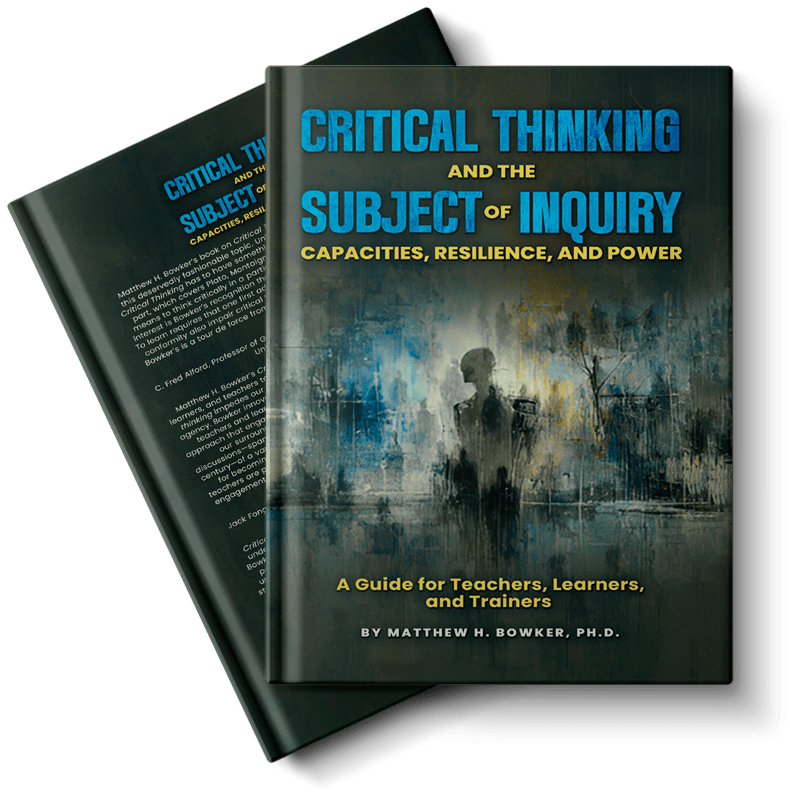
Critical Thinking and the Subject of Inquiry:
Capacities, Resilience, and Power — A Guide for Teachers, Learners, and Trainers
This book reframes critical thinking as an ongoing practice of subjectivity—the capacity to make meaning, to judge, and to maintain inquiry under pressure. It explains why skills alone often fail and shows how to cultivate the capacities and resilience that keep thinking alive when it matters most. Designed for teachers, learners, and trainers, the book offers clear explanations, discussion prompts, activities for classrooms and professional settings, and guidance on engaging the political, social, and psychological dynamics that shape thought.

ABOUT THE AUTHOR
Matthew H. Bowker, Ph.D.
Matthew H. Bowker, Ph.D., is an internationally recognized scholar of psychology, political philosophy, and critical thought. Educated at Columbia University and the University of Maryland, College Park, he has spent twenty-five years in university teaching, research, and administration. He is Research Associate Professor of Psychology at SUNY-University at Buffalo and SUNY Reconnect Lead Adult Learning Specialist at SUNY-Niagara. Bowker is the author of more than 20 books and over 40 scholarly articles and chapters. He founded and co-edits Routledge’s Psychoanalytic Political Theory book series and serves in several editorial roles with global reach, including Editor (North America) of the Journal of Psycho-Social Studies and Associate Editor of Psychoanalysis, Culture & Society. A U.S. State Department Fulbright Specialist in “Twenty-first Century Learning,” he has trained faculty and administrators both at home and abroad and has delivered 50+ keynotes worldwide. His recent books include: The Power of Being a Subject: Transcending Myth and Machine (Routledge, 2025), Getting Lost: Reflections on Psychopolitical Isolation and Withdrawal (Karnac, 2025, with A. Buzby), Oblation—Essays, Parables, and Paradoxes (Punctum Books, 2024), The Angels Won’t Help You: Essays (Punctum, 2022), and The Destroyed World and the Guilty Self: A Psychoanalytic Study of Culture and Politics (Karnac, 2019, with David P. Levine). Bowker has taught critical thinking for over two decades at Medaille University, SUNY-University at Buffalo, and the Singapore Institute of Management. His work on the relationship between critical thinking and subjectivity has been featured nationally and internationally in outlets such as National Public Radio (NPR), The Atlantic, and Elle Magazine (UK).
Endorsements
What Readers Are Saying
key features

For Educators
For K–12 teachers, department chairs, and instructional coaches who want durable critical thinking in daily lessons.
- Treat critical thinking as a capacity, not a checklist.
- Ready-to-use discussion prompts and classroom activities.
- Work directly with power dynamics that hinder inquiry.
- Practical methods to strengthen judgment and resilience

For Higher Education & Faculty Development
For universities, CTLs, program leads, and libraries building reflective courses & PD.
- Adopt for first-year seminars, general education, capstones, and graduate methods.
- Faculty workshops in facilitative pedagogy and learner-generated questioning.
- Tools to redesign syllabi toward subjectivity and autonomy.
- Support for reading groups and alignment with learning outcomes.

For Corporate & Professional Learning
For L&D teams, managers, & trainers who need stronger decisions under pressure.
- Build capacities: attention, boundary-setting, tolerance for ambiguity.
- Identify and counter organizational pressures that derail thinking.
- Use reflection prompts for debriefs and after-action reviews.
- Strengthen resilience and ethical judgment across teams.

For General Readers
For thoughtful readers of philosophy, psychology, and public life who want clear guidance without jargon.
- Short, accessible chapters that invite self-reflection.
- Self-study questions that translate insight into action.
- Recognize conformity pressures and sustain inquiry.
- Guided paths into classic texts that deepen understanding.